 Ano
Ano
Guide · Buying
What Actually Drives the Cost of an Anodizing Job
There is no rate card for Anodizing, and any shop that gives you a price per part without seeing the part is guessing. Six things move the cost, and understanding them is the difference between comparing quotes and comparing guesses.
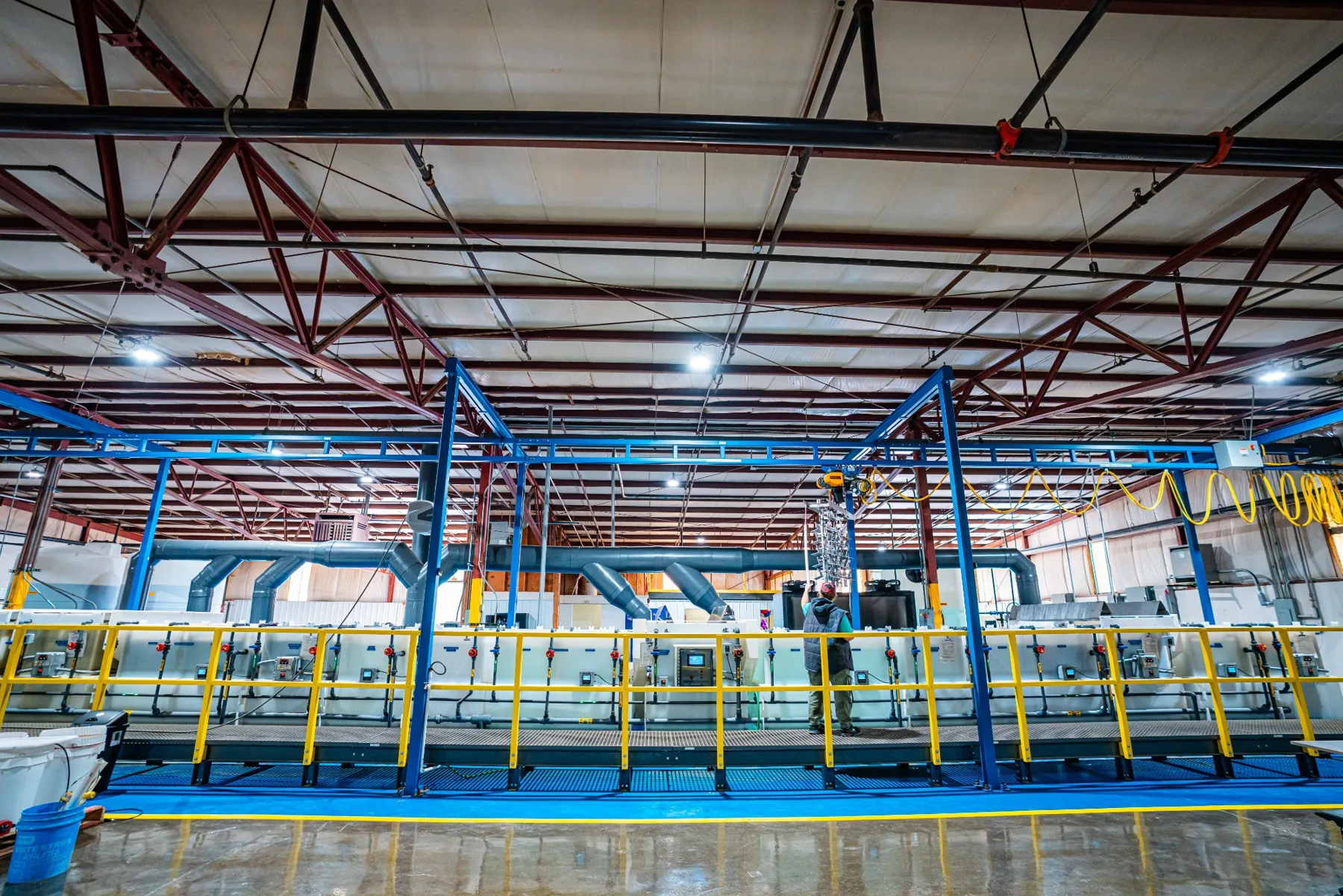 THE PLANT · PAOLI, INDIANA
Why Nobody Publishes a Price
Anodizing is not priced per part in any meaningful way, because two parts of identical weight can take wildly different amounts of work. A simple flat plate and a complex housing with six masked threads and two plugged bores are not the same job, and pricing them the same would mean overcharging one customer to subsidize the other.
What shops actually price is a combination of how much rack space your parts occupy, how much handling they need, which process runs, and what has to be protected while it runs. That is why we quote from a print and a count, and why minimum fees depend on which services a job requires. It is a slower answer than a price list and a considerably more accurate one.
The Six Things That Move Your Cost
1. Surface area, not weight. Anodizing costs are driven by the area being coated and the rack space consumed, because a tank load is a tank load. A hundred small brackets and ten large plates can occupy the same rack and cost similarly, which surprises people who expect to be charged by the pound.
2. Which process. Type II is the value option. Type III Hard Coat runs longer, colder and at higher current, so it costs more per unit area. Chem Film is generally the least expensive to apply. PTFE Impregnation adds a step on top of Hard Coat. None of that is negotiable between shops; it is physics and time.
3. Masking and plugging. This is the single biggest swing factor and the one buyers most often leave off a request for quote. Every thread that stays bare, every bore that gets plugged, every face that must not be coated is manual work performed on each individual part, twice, once to mask and once to unmask. A part with eight masked features can cost multiples of the same part with none.
4. Color and matching. Standard black and clear are routine. A specific color is more involved, and matching a customer's existing part or a supplied target adds setup and verification. Two colors on one part means running the part twice with masking in between.
5. Quantity and repeatability. Setup is a real cost and it is spread across the batch, so per-part cost falls as quantity rises. A standing repeat order is more efficient again, because the recipe is already recorded and the racking already worked out.
6. Turnaround. Standard scheduling is standard pricing. An expedite moves your parts ahead of work already committed to somebody else, and that has a cost. Our standard is 3 to 5 days and expedites run as fast as same day when the schedule allows.
The Cost Nobody Quotes For
A late finisher. If a finishing vendor misses your date, the cost is not the finishing line item, it is your own delivery commitment to your customer. That is worth weighing against a lower cost, and it is the reason we tell you before you accept a quote if we cannot hold your date rather than after.
| FACTOR | EFFECT ON COST | CONTROLLED BY |
|---|---|---|
| Surface area and rack space | Primary driver | The part design |
| Process type | Substantial; Hard Coat exceeds Type II | The drawing |
| Masking and plugging | Can multiply the cost | The drawing, and what you call out |
| Color and matching | Moderate; matching adds setup | The specification |
| Quantity | Per-part cost falls with volume | The order |
| Expedite | Premium against standard scheduling | Your schedule |
| Alloy | Little direct cost effect | The material |
How to Get a Quote You Can Actually Compare
Send four things and you will get a cost the same working day: the print or a clear description, which process the part needs, how many parts there are, and the date you need them back. Add the alloy if you know it, because it affects what we can promise on appearance.
When you compare quotes, check that everybody is quoting the same job. The most common source of a suspiciously low cost is a shop that has not accounted for masking, or that has quoted Type II against a drawing that called for Hard Coat. A quote that does not mention the features you asked to be protected is not cheaper; it is incomplete.
Also check what happens to your date. A price is only a price if the parts arrive when you were told they would.
The Quote Questions Worth Asking a Finisher
Five questions separate a vendor who has thought about your part from one who has priced it by weight.
What did you assume about masking? If the answer is vague, the quote is vague.
What coating thickness did you quote? On Hard Coat this drives both cost and whether your fits still work.
Is that date a commitment or an estimate? The difference matters more than the cost.
What happens if the first article is not right? A shop with a real answer has had the situation before.
Will you tell me before you run if the drawing is ambiguous? The only acceptable answer is yes.
None of those are adversarial questions. They are the questions a buyer asks when they intend to place repeat work with somebody rather than buy one job at the lowest cost.
Ways to Reduce the Cost That Are Worth Considering
Reconsider what genuinely needs masking. It is the largest controllable cost. Some features are called out as bare from habit rather than function, and every one you can release saves manual work on every part.
Check whether Hard Coat is genuinely required. If nothing rubs against the surface, Type II protects well, costs less and opens the full color range. Hard Coat specified defensively is common and expensive.
Batch your orders. Setup spreads across quantity. Four small orders across a quarter cost more than one order of the same total, and a predictable repeat schedule is cheaper still.
Give realistic lead time. Standard scheduling avoids expedite premiums entirely, and most jobs are not genuinely urgent when the schedule is planned rather than reacted to.
Common Questions
How Much Does It Cost to Anodize Aluminum?
There is no honest single answer, which is why we do not publish a rate card. Cost is driven by surface area and rack space, which process runs, how much masking is involved, color requirements, quantity and turnaround. Send a print and a count and you will have a real cost by email rather than a rule of thumb.
Why Will You Not Give a Price Over the Phone?
Because a price given without seeing the part is a guess, and guesses are usually wrong in the direction that causes an argument later. Two parts of identical weight can take very different amounts of work, mostly depending on what has to be masked. Send the drawing and we will quote it properly.
Is Anodizing Priced by Weight or by Size?
Neither exactly. It is driven by the surface area being coated and the rack space the parts consume, because a tank load is a tank load. This surprises people expecting to be charged by the pound, and it is why a hundred small parts and ten large ones can price similarly.
What Makes One Anodizing Quote Much Cheaper Than Another?
Most often the two quotes are not for the same job. Check whether the cheaper one accounted for the masking you asked for and quoted the process the drawing actually called out. Also check the promised date, because a price is only a price if the parts arrive when you were told.
Does Hard Coat Cost More Than Type II?
Yes. Type III runs longer, at lower temperature and higher current density, so it consumes more time and energy per unit area. If nothing on your part rubs against anything, Type II protects well and costs less, so Hard Coat specified defensively is a common and avoidable expense.
How Can I Reduce What I Spend on Finishing?
Review what genuinely needs masking, since it is the largest controllable cost and some features are called out as bare from habit. Confirm Hard Coat is really required. Batch orders so setup spreads across more parts. And give standard lead time where the job is not truly urgent.
Do You Have Minimum Fees?
Yes, and they depend on which services a job requires rather than being a single flat figure, for the same reason the per-part cost does. Small batches are quoted every week here and are entirely normal work.
Keep Reading
Send Four Things, Get a Real Cost.
The print, the process, the count and the date. A quote comes back by email with the date already on it.