 Ano
AnoService
PTFE Impregnated Anodizing for Parts That Slide
Hard Coat Anodizing impregnated with PTFE, so the wear surface carries its own dry lubricant. Commonly specified under AMS 2482, for sliding parts that cannot be greased.
Start here
What Does PTFE Impregnation Actually Do?
It puts the lubricant inside the wear surface instead of on top of it.
A hard anodic coating is porous at the microscopic level, the same property that lets dye work on Type II. Impregnation drives PTFE down into those pores, so the finished part carries a dry lubricant within the hardened surface itself. There is no grease to apply, no film to reapply, and nothing that can rub off, because there is no separate layer to lose.
The parts that need this are the ones you already know: valves, pistons, guides, actuators, cams, and packaging machinery components. Anywhere an aluminum part moves against another surface and a wet lubricant would be a contamination problem, a maintenance burden, or simply impossible to reach.
Where it earns its keep
The Parts That Cannot Be Greased
Food and packaging equipment is the clearest case. Wet lubricant near a product line is a contamination question nobody wants to answer, so the moving aluminum has to be self-lubricating or it has to be something other than aluminum. Medical assemblies land in the same place for the same reason, with cleanliness driving it in place of food safety.
Automation is the third lane, and there the driver is maintenance. A guide that has to be greased is a guide somebody has to reach, on a schedule, forever. A guide that lubricates itself is one line removed from the maintenance plan, and over a machine's life that is worth more than the finish costs.
 DARK FINISH WORK · THE BENCH
The specification
AMS 2482 and What Your Print Is Asking For
PTFE Impregnated Hard Coat is most often specified under AMS 2482, the SAE aerospace material specification for exactly this process. If your drawing carries that callout, this page is the process it is describing, and our AMS 2482 page covers what the specification requires in detail.
You may also see it called out by trade name. Those are proprietary versions of the same idea, and a drawing citing AMS 2482 does not oblige you to buy a particular brand. Underneath the impregnation step, the base coating runs exactly like our standard Hard Coat Anodizing. SAE publishes the AMS specifications at sae.org/standards.
How it runs in Paoli
PTFE Impregnation, Step by Step
Confirm What the Print Wants
An AMS 2482 callout, or a performance need described in plain words. We confirm the coating build and the impregnation approach on the quote so there is no ambiguity to resolve mid-run.
Hard Coat First
The part gets a Type III hard anodic coating, grown dense and porous. Everything the finished part does depends on this step being right.
Impregnate the Pores
PTFE goes down into the coating's pore structure, becoming part of the wear surface rather than a layer resting on it.
Check the Finish and Return
The finish is verified against the callout, packed, and returned on the standard 3 to 5 day clock. One shop, both steps, no second vendor trip.
Questions
PTFE Impregnated Anodizing Questions
Is PTFE Impregnation the Same as a Teflon Coating?
No, and the difference is the whole point. A sprayed coating sits on top of the part as a film and wears off the surface first. Impregnation puts PTFE inside the pores of the hard anodic layer, so the lubricant is part of the wear surface and cannot flake away from it.
What Color Does PTFE Impregnated Hard Coat Come Out?
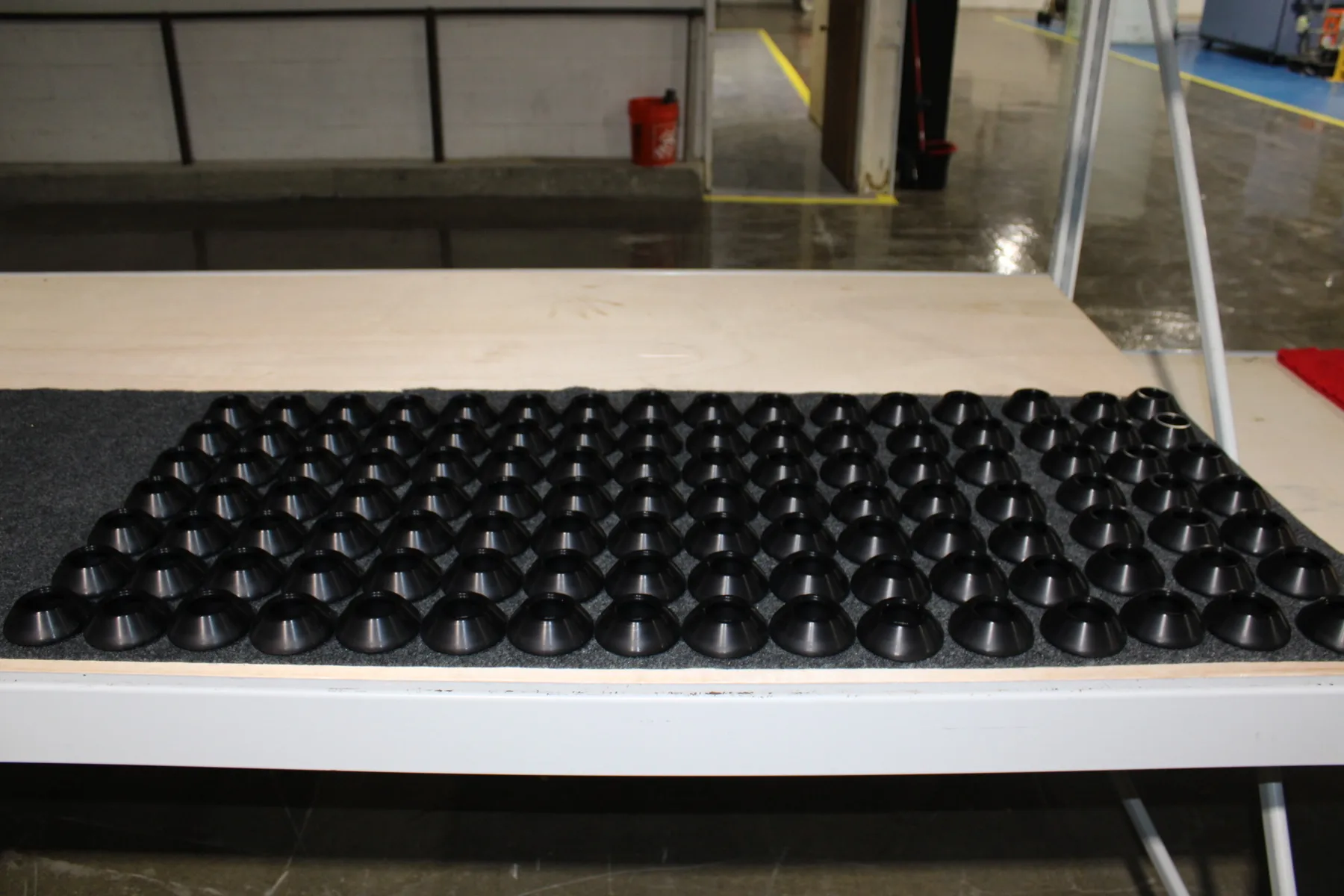
Typically dark gray to black, consistent across the batch. The exact tone depends on the alloy and the coating thickness, so if appearance matters on your part, say so and we will tell you what to expect.
Can You Apply PTFE to Hard Coat We Already Have?
The impregnation is applied as part of the coating process rather than afterward, so plan for us to run the Hard Coat and the impregnation together. Send the print and we will confirm how your particular part should be sequenced.
How Long Does the Dry Lubrication Last?
As long as the coating does, because the PTFE lives inside the oxide pores, not on the surface. It wears only as the Hard Coat itself wears. That is the practical advantage over any sprayed film, which loses its lubricant long before the substrate gives out.
Is It Suitable Near Food or in a Cleanroom?
PTFE Impregnated Hard Coat is a dry, clean surface and it is widely used on packaging and food machinery components for that reason. Put your specific compliance requirement on the request for quote and we will confirm fit instead of assuming it.
Does the Impregnation Add Thickness?
Effectively no. The PTFE occupies pore volume that already exists inside the coating, so the dimensional change is the Hard Coat's, and nothing more. Size the allowance for the Hard Coat and you have sized it for this.
Where to go next
The Specification, the Base Coating, and the Buyers Who Use It
Impregnation sits on top of a Hard Coat, so the two pages are worth reading together. If your drawing cites the specification rather than the process, start with the AMS 2482 page.

Ready when you are
Dry-Lubricated Parts, Quoted This Week.
PTFE Impregnated Hard Coat to AMS 2482, run from your print in one building.