 Ano
Ano
Guide · Comparison
Anodize or Alodine: Choosing Between Them
One insulates and one conducts. That single difference settles most drawings, and everything else is a secondary consideration. We run both processes in the same building, so this comparison is not an argument for whichever one we happen to sell.
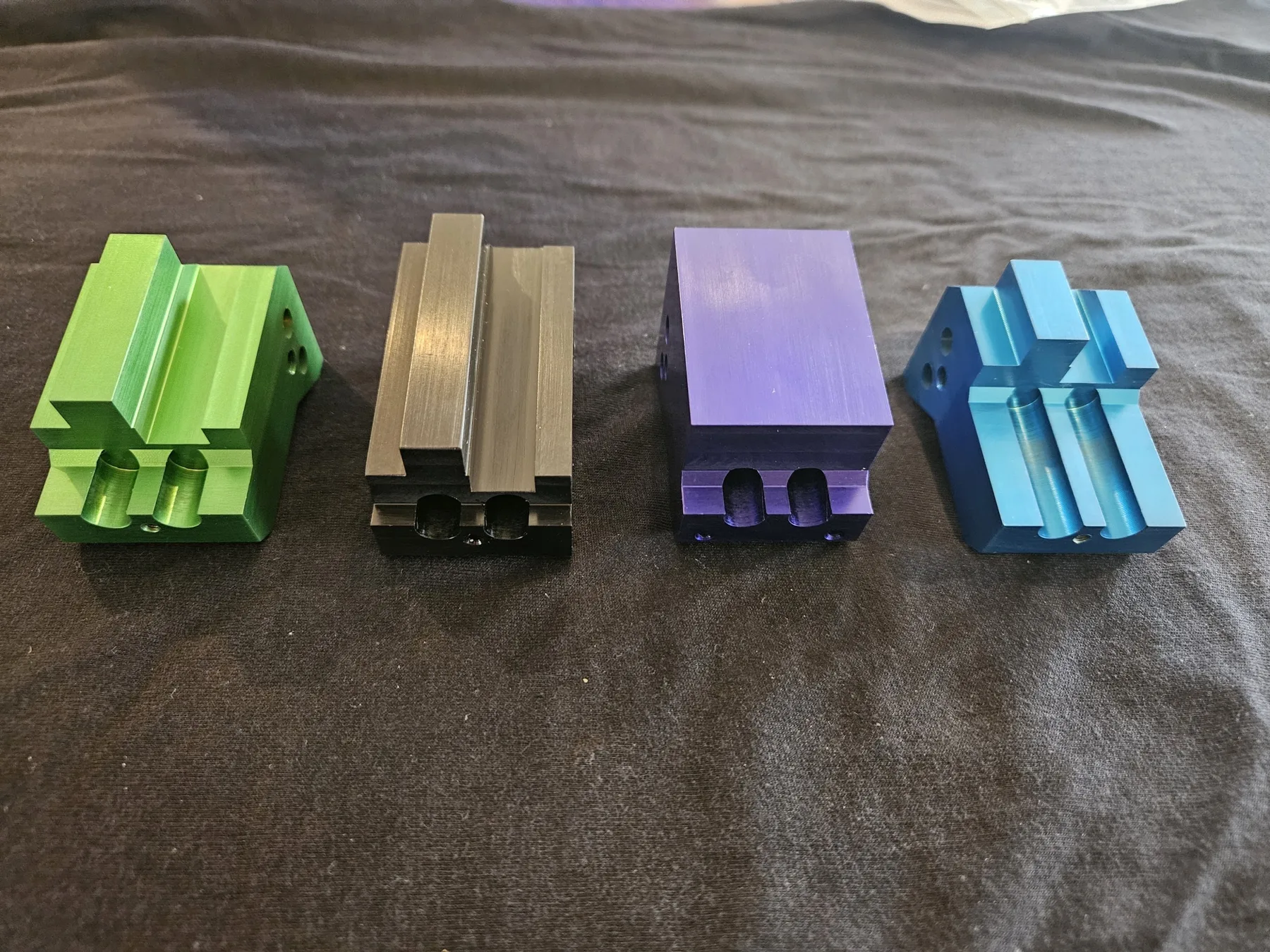 TYPE II DYED · CUSTOMER PARTS
Start With One Question
Does any part of this surface need to carry electricity? If yes, the answer is a chemical conversion coating, sold as Alodine or Chem Film and specified to MIL-DTL-5541. If no, Anodizing is almost always the better finish and the rest of this guide is about choosing which kind.
The reason is that Anodizing grows an aluminum oxide layer, and aluminum oxide is a good electrical insulator. On a bracket, a housing exterior or a wear surface that is irrelevant or helpful. On a ground path, a bonding surface or an EMI shielding face, it is a failure, and it is a failure that passes visual inspection perfectly.
| PROPERTY | ANODIZING | ALODINE / CHEM FILM |
|---|---|---|
| Electrical conductivity | Insulates | Conducts, and Class 3 is specified for it |
| Thickness added | 0.0001 to 0.004 in depending on type | Under 0.0001 in, effectively negligible |
| Wear resistance | Good on Type II, excellent on Hard Coat | Minimal; it is a thin chemical film |
| Corrosion resistance | Very good, better when sealed | Very good, and Class 1A is the heavy option |
| Color options | Clear, black and a full dye range | Clear or gold only |
| Base for paint | Workable, but not the standard choice | The standard base on aluminum |
| Appearance | Durable, decorative, consistent | Utilitarian; gold is visible, clear is not |
| Governing spec | MIL-A-8625 | MIL-DTL-5541 |
When Anodizing Is Clearly Right
Anything that wears. A sliding surface, a guide, a piston, a fixture that gets handled constantly, tooling, an actuator body. A hard anodic coating is harder than most tool steels and it is the only one of the two options that addresses abrasion at all.
Anything where appearance is part of the product. Anodizing gives you clear, black and a full range of dyed colors, all of them living inside the coating where they cannot chip. A Chem Film part comes out clear or gold and that is the whole palette.
Anything that needs real corrosion protection with physical durability behind it. A sealed anodic coating handles both, whereas a conversion coating protects chemically but will not survive being scraped.
When Alodine Is Clearly Right
Anything electrical. Ground planes, bonding surfaces, connector faces, chassis that form part of a shielding scheme, and any assembly where two aluminum parts have to make a reliable low-resistance joint.
Anything with no dimensional headroom. If the tolerance stack has nothing left in it and the drawing is fighting the Anodizing allowance, a conversion coating solves the problem by not adding meaningful thickness.
Anything about to be painted. Conversion coating is the standard base for paint systems on aluminum, and skipping it is a common cause of adhesion failures on painted aluminum assemblies.
And Frequently the Answer Is Both
A machined enclosure with an anodized exterior and conversion-coated grounding pads is an ordinary part, not an exotic one. The zones get marked on the print, we mask to them, and the processes run in the right order so neither undoes the other. Because both happen in our building, that part stays one job with one date on it instead of travelling between two vendors.
How the Decision Usually Gets Made in Practice
In our experience the drawing has already decided, and the question reaching us is really a question about whether the drawing is right. So it is worth walking the logic the way a designer should.
Start with function. Does any surface carry current, ground, bond or shield? Those surfaces need a conversion coating, full stop, whatever the rest of the part gets. Then look at wear. Does anything slide, rotate, clamp or rub? Those surfaces need Anodizing, and probably Hard Coat. Then look at the tolerance stack, because if there is no dimensional headroom left, Anodizing has to be masked away from the critical features or the part has to be re-dimensioned.
Only after those three does appearance enter, and by then the answer is usually already fixed. Deciding on appearance first is how parts end up beautifully anodized and electrically dead.
What Each One Costs You in Trade-Offs
Choosing Anodizing costs you conductivity and dimension. You cannot recover either afterward, because removing an anodic coating removes base metal along with it. It also costs a little more to apply, and on Hard Coat it costs design effort in every fit on the part.
Choosing a conversion coating costs you wear resistance and color. There is no version of Chem Film that survives abrasion, and the palette is clear or gold. It is also a thinner barrier, so on a part facing sustained weather exposure Class 1A is doing real work at the edge of its capability where a sealed anodic coating would be comfortable.
Neither trade is hidden and neither is negotiable between vendors. Any shop telling you their Chem Film wears like Hard Coat, or their Anodizing conducts, is selling rather than explaining.
Things People Believe That Are Not True
"Alodine is the cheap option." It is generally less expensive to apply, but it is not a budget substitute for Anodizing. They protect differently and a part that needed wear resistance is not cheaper for having been conversion coated; it is simply wrong.
"Anodizing is always more durable." More abrasion resistant, yes, always. But a Chem Film surface that is doing its actual job, carrying current under a bolted joint, will outlast an anodized surface in that role indefinitely, because the anodized one never worked.
"You can anodize now and add Chem Film later if it turns out you need conductivity." You cannot, not on the same surface. Removing an anodic coating removes base metal with it. Decide before the parts run.
Common Questions
What Is the Main Difference Between Anodize and Alodine?
Anodizing grows an aluminum oxide layer that insulates electrically and adds real thickness and wear resistance. Alodine is a thin chemical conversion coating that protects against corrosion while leaving the surface conductive and adding almost no dimension. If the part must carry current, that difference decides it on its own.
Which One Protects Against Corrosion Better?
Both protect well within their design intent. A sealed anodic coating gives durable protection with abrasion resistance behind it. Class 1A Chem Film is the heavier conversion option and protects chemically but will not survive abrasion. The right question is usually what else the part has to do.
Can You Put Alodine Over Anodizing?
Not usefully on the same surface. The anodic layer is already a barrier and a conversion coating has nothing to react with. What is common and entirely practical is different finishes on different areas of one part, achieved with masking.
Which Is Better for a Part That Will Be Painted?
Chem Film. It is the standard base for paint on aluminum and gives markedly better adhesion than bare metal. Tell us the paint specification with the request so the class selection matches it.
Do You Run Both Processes in the Same Shop?
Yes, both in our building in Paoli, Indiana. That is the reason a part needing Anodizing on one surface and Chem Film on another stays a single job with a single date, instead of making a trip between two vendors and collecting a second transit time.
Does One of Them Last Longer Than the Other?
They fail in different ways rather than at different speeds. A sealed anodic coating degrades mainly through abrasion; a conversion coating degrades mainly through chemical exposure once its film is compromised. On the job each is designed for, both last a long time. On the wrong job, either fails quickly.
Can One Part Have Anodizing on One Face and Alodine on Another?
Yes, and it is an ordinary job rather than an exotic one. The zones are marked on the print, we mask to them, and the two processes run in the correct order so neither damages the other. Because both happen in our building, that part keeps one date instead of travelling between two vendors.
Which One Is Cheaper?
Chem Film is generally less expensive to apply, but the two are not interchangeable, so the comparison rarely decides anything on its own. We quote each job from the print and the count, so send the drawing and you will have a real cost rather than a rule of thumb.
Keep Reading
Not Sure Which One Your Part Needs?
Send the print and tell us what the part does. Reading a drawing with a customer is a normal part of the day here.